
Managing your own fulfillment feels like juggling knives. Inventory tracking. Carrier negotiations. Returns processing. Warehouse staffing. Each task adds another blade in the air.
One mistake and everything crashes down. A lost shipment angers a customer. An inventory error causes a stockout. A carrier delay costs you trust.
3PL logistics providers catch these knives. They turn chaos into control.
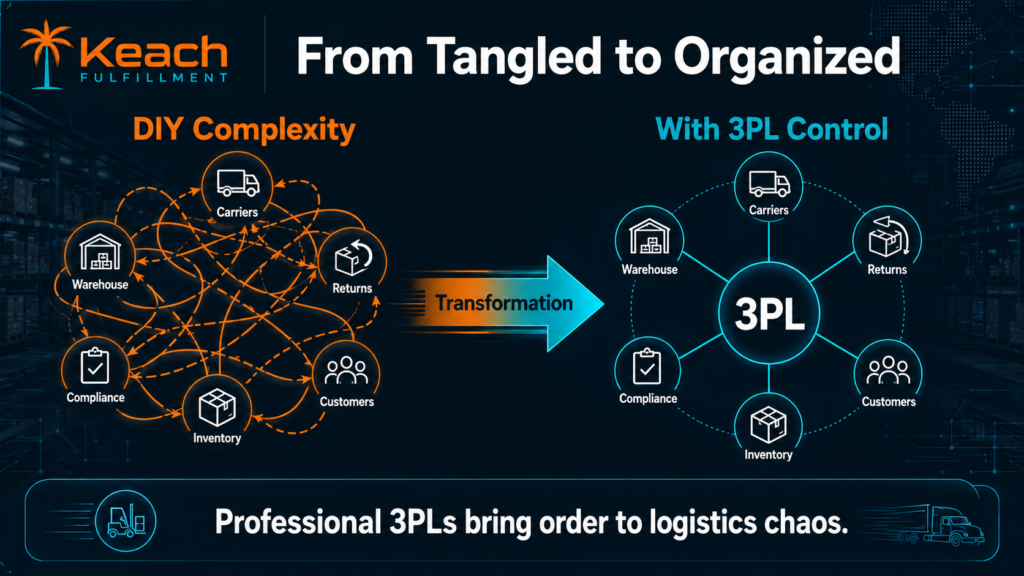
Professional 3PLs bring order to the chaos.
Get Control Keach FulfillmentWhat Makes a 3PL Logistics Service Provider Different?
A 3PL logistics service provider does more than ship boxes. They build systems that remove complexity from your operations.
Technology integration connects your sales channels directly to their warehouse. Orders flow automatically. Inventory syncs instantly. You do not need to manually enter data or update spreadsheets.
Process standardization ensures every order follows the same steps. Receiving, storage, picking, packing, and shipping all happen in a consistent workflow. No shortcuts and no variation.
Performance tracking helps identify issues before they reach customers. Accuracy rates, shipping speeds, and inventory levels are monitored daily so problems are caught early.
How Does a 3PL Third Party Logistics Provider Simplify Operations?
A 3PL third party logistics provider absorbs the operational workload that slows your business down.
Carrier management is handled entirely for you. The 3PL maintains relationships with UPS, FedEx, USPS, and regional carriers. They negotiate rates and resolve issues so you do not have to.
Warehouse staffing is no longer your responsibility. The provider hires, trains, and manages all warehouse workers. You never deal with scheduling or labor issues.
Returns processing is also handled inside their facility. Customers send returns directly to the 3PL. Items are inspected, restocked, or disposed of, and your system updates automatically.
Compliance requirements are managed by experts who already understand platform rules, packaging standards, and labeling requirements.
Professional 3PLs handle the complexity so you do not have to.
Simplify NowWhat Logistics Management Consulting Services Should You Look For?
Logistics management consulting services help you design a more efficient supply chain. The right 3PL provider includes these capabilities.
Network design evaluates where your inventory should be stored based on customer locations. It answers whether you should use one warehouse or multiple regional locations.
Carrier selection ensures your shipping setup matches your order profile. Package weight, destination zones, and delivery expectations are analyzed to reduce cost and improve speed.
Packaging optimization focuses on reducing waste and cost. Proper box sizing lowers dimensional weight charges and reduces damage during transit.
Technology assessment ensures your sales channels, inventory systems, and accounting tools are properly connected for smooth data flow.
How Do You Measure 3PL Success?
Moving from complexity to control requires tracking the right performance metrics.
Order accuracy shows whether customers receive the correct items. Leading 3PL logistics providers maintain 99.5 percent or higher.
On time delivery measures how consistently shipments arrive within promised timeframes. A strong provider should maintain at least 98 percent performance.
Inventory accuracy compares system data with physical stock levels. High performing 3PLs stay at 99 percent or better.
Returns processing time impacts customer satisfaction and brand trust. Faster turnaround improves the customer experience.
Cost per order tracks your total fulfillment expense and should improve as your order volume grows.
In our previous guide, Beyond Shipping: The Business Impact of Modern 3PL Logistics, we explored how 3PLs affect inventory, cash flow, and customer experience. These metrics confirm whether those benefits are being delivered in practice.
When Does Complexity Turn into Control?
The shift from complexity to control does not happen overnight. It shows up in small but meaningful ways.
You start noticing fewer emergency calls. Shipping issues stop landing on your desk. Inventory questions are already resolved before you ask them.
Better sleep follows. You stop worrying about lost shipments or system errors because the 3PL is tracking everything in real time.
Eventually, more time becomes available for growth. You focus on marketing, product development, and customer relationships while logistics runs in the background.
Conclusion
3PL logistics transforms fulfillment from a constant struggle into a controlled system. A professional 3PL logistics service provider manages carriers, staffing, returns, and compliance so you can focus on growth.
At Keach Fulfillment, we operate as a trusted 3PL third party logistics provider for growing ecommerce brands. Our logistics management consulting services help design efficient, scalable operations that remove unnecessary complexity.
Let our 3PL expertise simplify your supply chain.
Contact Keach Fulfillment