
Amazon FBA and third party logistics sound similar on the surface. Both store your inventory. Both pick, pack, and ship orders. Both promise to save you time. So why do some sellers swear by one and avoid the other entirely?
The answer comes down to control, cost, and how your business operates. FBA is a packaged service with strict rules. A 3PL is a partnership with flexibility. Each model serves different needs. Picking the wrong one creates friction that costs money and slows growth.
The Core Difference in Simple Terms
Amazon FBA is a fulfillment service owned by Amazon. You send inventory to their warehouses. They handle storage, shipping, and customer service for Prime orders. The trade-off is control. Amazon sets the rules. You follow them.
A regular third-party logistics provider is an independent company. They store your inventory in their warehouse. They ship orders to any sales channel you use. You keep more control over branding, packaging, and customer experience.
Think of FBA as renting space in someone else’s house. A 3PL is more like hiring a team to run your own operation.
How FBA and 3PL Handle Storage
Storage works differently in each model. FBA warehouses are optimized for speed. Amazon prioritizes fast delivery to Prime customers. Inventory sits close to population centers. But storage fees rise during peak seasons. Long-term storage penalties apply to slow-moving products.
A 3PL warehouse operates on your terms. You pay for the space you use. Rates are more predictable. You can store inventory as long as needed without facing the same penalties.
Order Fulfillment and Shipping Speeds
FBA wins on speed for Prime orders. Amazon’s network delivers in one or two days. That speed is hard to match. Customers see the Prime badge. They click buy.
A 3PL ships based on your chosen carriers and service levels. Standard ground shipping takes longer. But you can offer expedited options. You can also ship orders from any platform, not just Amazon.
For sellers running multiple channels, a 3PL simplifies operations. One warehouse handles everything. FBA requires separate inventory for Amazon orders.
How Does 3PL Pricing Work: Flat Rate vs Per-Order Pick and Pack Fees
Pricing is where the comparison gets interesting. How does 3PL pricing work: flat rate vs per-order pick and pack fees? Understanding this helps you estimate costs accurately.
A flat rate model charges a fixed fee per order. It does not matter how many items are in the box. One fee covers the pick, pack, and ship. This works well for single-item orders.
Per-order pick-and-pack fees charge based on activity. You pay for each item picked. You pay for the packaging materials. You pay for the labor. This model suits complex orders with multiple items.
Most 3PLs use a hybrid approach. They charge a base fee plus per-item charges. The total depends on your order profile.
Here is a visual breakdown of common 3PL pricing components:
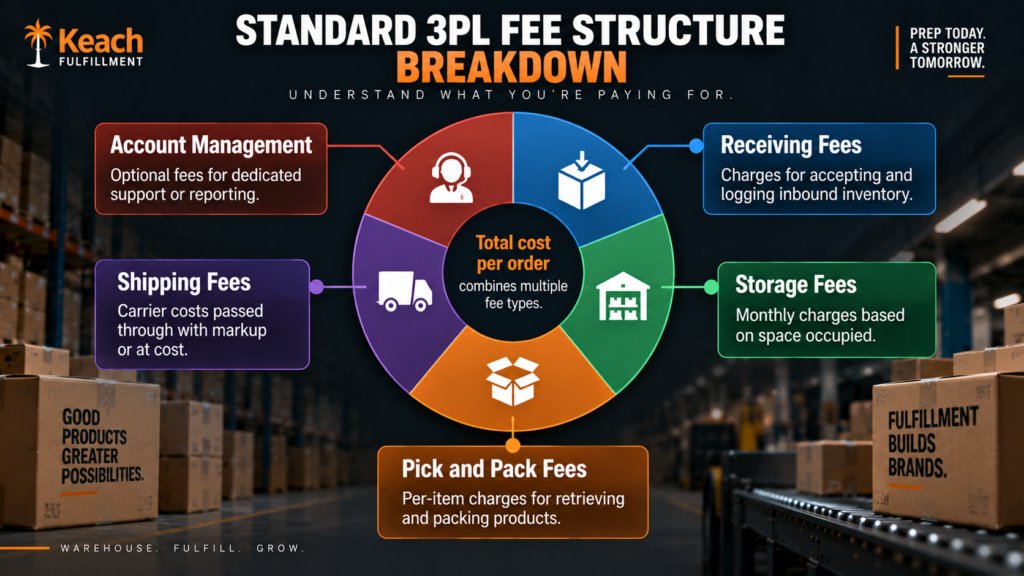
Itemized Pick and Pack Pricing vs Flat Rate Order Fulfillment Fees
The choice between itemized and flat rate affects your margins. Itemized pick and pack pricing vs. flat-rate order fulfillment fees comes down to your average order size.
If most orders contain one item, flat rate is simpler. You know the cost upfront. If orders often include multiple items, itemized pricing might be cheaper. You pay for what you use.
Run the numbers based on your actual order history. A 3PL can model both scenarios. They show you which option saves money.
Which Model Fits Your Business
FBA suits sellers focused on Amazon. The speed and Prime badge drive conversions. The tradeoff is control and cost predictability.
A 3PL suits sellers with multiple channels. The flexibility and branding control matter more than Prime speed. Costs are more predictable.
Our blog explains the best 3PL for a small business just starting if you are new to outsourcing fulfillment.
Standard 3PL Fee Structures Explained for E-Commerce Store Owners
Beyond pick and pack, several other fees appear on invoices. Standard 3PL fee structures explained for e-commerce store owners should include receiving, storage, and returns processing.
Receiving fees cover inbound inventory. The 3PL unloads, counts, and logs your products. Storage fees cover the space you occupy. Returns processing covers inspection and restocking of returned items.
Ask for a complete fee schedule before signing. Hidden charges destroy trust. A transparent 3PL lists every possible cost.
How to Calculate Total 3PL Fulfillment Cost Per Order
Crunching the numbers prevents surprises. How to calculate total 3PL fulfillment cost per order requires adding all components.
Start with pick and pack fees. Add shipping costs. Include storage allocated per order. Factor in receiving and returns. Divide by monthly order volume.
This total tells you what fulfillment actually costs. Compare it against FBA fees and your own in-house costs. The answer reveals the most economical option.
FBA Prep vs 3PL Fulfillment
Some sellers use both. FBA prep vs 3PL fulfillment is not always an either-or decision. A 3PL can prepare inventory for FBA. They label, polybag, and bundle products. Then they ship to Amazon warehouses.
This hybrid approach works for sellers who want FBA speed but need prep support. The 3PL handles compliance. Amazon handles delivery.
This guide covers which US city is best for a 3PL fulfillment center if you are deciding on location.
The right choice depends on your business.
Contact Keach Fulfillment to get clarity before you commit.Making the Decision
Start by mapping your sales channels. If Amazon is your only channel, FBA makes sense. If you sell on multiple platforms, a 3PL simplifies operations. Consider your growth plans. FBA limits how you scale outside Amazon. A 3PL grows with you across channels. Review your margins. Calculate total costs for each option. Include storage, shipping, and any prep work. The numbers often make the decision obvious.
Conclusion
The difference between Amazon FBA and a regular third-party logistics provider comes down to control and flexibility. FBA offers speed and simplicity within Amazon’s ecosystem. A 3PL offers freedom to operate across channels with your own branding. Keach Fulfillment works with sellers who need that flexibility. We handle storage, shipping, and prep for businesses of all sizes. The right fulfillment partner makes growth easier. Choose the model that matches your ambitions.