
Scaling an online store brings a particular kind of problem that most founders don’t anticipate: success becomes operationally exhausting. You’re selling more products, which sounds great until you’re spending entire weekends packing boxes instead of growing your business. That’s where ecommerce fulfillment services enter the picture, and understanding how they work can completely change your trajectory as a seller.
What Ecommerce Fulfillment Actually Means
Ecommerce order fulfillment is the complete process of getting products from your warehouse shelf into customers’ hands. It starts when someone clicks “buy” on your Shopify store and ends when the package arrives at their door. Everything in between, picking the product from storage, packing it securely, generating shipping labels, coordinating carrier pickup, and tracking delivery, falls under fulfillment operations.
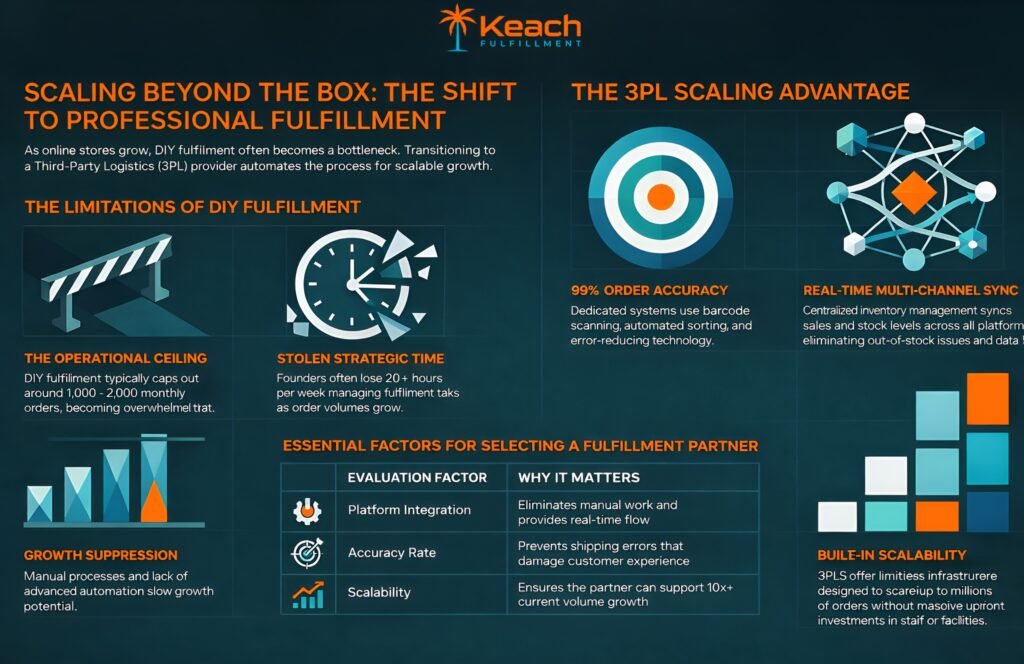
Most online stores handle this themselves initially. You receive inventory at home, store products in your garage or spare room, and pack orders as they come in. This works fine at 10 orders per week. At 100 orders weekly, it’s consuming your life. At 1,000 orders monthly, it’s literally impossible without dedicated help.
The transition point varies by business, but there’s usually a moment when founders realize they’re spending more time on logistics than on the activities that actually grow revenue: sourcing better products, improving marketing, optimizing conversion rates, or expanding to new channels.
When DIY Fulfillment Stops Making Sense
Several clear signals indicate you’ve outgrown self-managed fulfillment. If you’re working nights and weekends just to keep up with order processing, that’s time stolen from strategic work. When inventory sprawls across multiple rooms in your house or you’re renting storage units just to hold stock, space constraints are limiting growth.
Customer complaints about shipping speed often surface because you can’t process orders fast enough. Packing errors increase when you’re rushing through fulfillment to clear backlogs. These mistakes damage your reputation and create expensive reshipping costs.
Perhaps most telling: you’ve turned down wholesale opportunities or avoided running promotions because you can’t handle the fulfillment volume spike. That’s leaving money on the table directly because of operational constraints.
How a 3PL for Ecommerce Changes Operations
A third-party logistics provider (3PL for ecommerce) takes over the physical work of fulfillment. You send inventory to their warehouse instead of yours. They receive it, organize it in their storage systems, and integrate with your ecommerce platforms. When orders come in from Shopify, Amazon, WooCommerce, or wherever you sell, those orders flow automatically to the 3PL’s warehouse management system.
Their staff pick products from shelves using barcode scanners for accuracy. They pack items with appropriate protective materials and proper box sizing. Shipping labels generate automatically, and packages move to carrier pickup areas. Tracking information flows back to your store and customers receive shipping notifications, all without you touching a single box.
The best ecommerce fulfillment services maintain accuracy rates above 99% through systematic verification. They ship orders faster because they’re doing this all day, every day. They get better shipping rates through volume discounts you can’t access independently.
Breaking Down the Actual Fulfillment Process
Understanding the workflow helps evaluate potential partners. When your inventory arrives at an ecommerce fulfillment company, the receiving team counts everything, inspects for damage, and logs products into their warehouse management system. Each item gets a storage location assignment based on size, turnover rate, and logical grouping.
The system tracks exactly where every unit sits. When a customer orders, the software knows precisely which shelf holds that product. A pick list directs warehouse staff to the exact location. They scan the product barcode to verify they grabbed the right item.
At packing stations, staff select appropriately sized boxes, add protective materials, and include any custom elements you’ve requested, branded tissue paper, thank-you cards, promotional inserts. The package gets weighed, a shipping label prints with the best carrier rate for that destination and service level, and the completed order moves to the shipping queue.
Simultaneously, inventory counts update in real-time. Your Shopify store shows one fewer unit available. If you sell on multiple channels, all platforms see the updated count instantly. This synchronization prevents overselling across platforms.
Choosing the Right Fulfillment Partner
Not all fulfillment providers are equivalent. Experience with your product category matters, an ecommerce fulfillment company that handles mostly apparel might struggle with fragile electronics or perishable goods. Ask about their experience with products similar to yours.
Technology integration is non-negotiable. The fulfillment provider must connect directly to your ecommerce platforms. Manual order uploading creates delays and errors. Real-time inventory synchronization prevents overselling. You need dashboard access showing current inventory and order status without requesting reports.
Location affects shipping costs and speed. A warehouse in a central US location typically ships to more customers in 2-3 days ground compared to coastal warehouses. However, if 80% of your customers are in California, a West Coast warehouse makes more sense despite being “less central” nationally.
Pricing transparency separates good partners from problematic ones. You should understand all fees: receiving charges, monthly storage costs, pick and pack fees, shipping rates, and any special handling charges. Hidden fees that appear on invoices after you’ve committed are red flags.
Scalability matters even if you’re small now. Can they handle 10x your current volume? Switching fulfillment providers is painful. Starting with a partner who can grow with you avoids future disruption.
| Evaluation Factor | Why It Matters | Questions to Ask |
| Platform Integration | Prevents manual work and errors | Which ecommerce platforms do you integrate with directly? |
| Accuracy Rate | Affects customer satisfaction and returns | What’s your order accuracy percentage? |
| Shipping Speed | Impacts customer experience | What’s your average order-to-ship time? |
| Pricing Structure | Determines profitability | Can you provide a complete fee schedule? |
| Scalability | Supports business growth | What’s your maximum capacity? |
Common Fulfillment Mistakes to Avoid
Many sellers choose fulfillment partners based solely on price, then regret it when quality suffers. The cheapest option often means the least experienced staff, the oldest technology, and the most errors. Those errors cost more than the money saved on fees.
Failing to test the partnership before fully committing creates problems. Send a small batch of inventory first. Place test orders. Verify that integrations work correctly and accuracy meets promises. Discovering issues after moving all your inventory is exponentially more painful.
Not clarifying storage limits causes surprises. Some providers charge dramatically higher rates after you exceed certain cubic footage or pallet counts. Understand the pricing structure for your expected inventory levels.
Overlooking return handling creates customer service headaches. How does the fulfillment provider process returns? Can they inspect returned items and restock sellable products? What’s the cost structure? Returns are inevitable in ecommerce, so the process needs to work smoothly.
The Real Cost-Benefit Analysis
Outsourcing ecommerce fulfillment services isn’t free, but neither is self-managed fulfillment. When calculating costs, include your time at its actual value. If you spend 20 hours weekly on fulfillment and your time is worth $50/hour (a conservative estimate for a business owner), that’s $1,000 weekly in opportunity cost.
Add direct costs: warehouse or storage space, packing materials, shipping supplies, equipment like scales and label printers, and any part-time help you’ve hired. Many sellers are shocked when they calculate their true self-fulfillment costs.
Professional fulfillment might cost 60-70% of self-managed expenses directly, but it frees 20+ hours weekly for revenue-generating activities. If that time generates even modest additional sales, the ROI becomes obvious.
There’s also the quality improvement. Professional fulfillment typically ships faster and more accurately than overwhelmed solo operations. Better customer experience means fewer returns, better reviews, and higher repeat purchase rates.
Multi-Channel Selling and Fulfillment
Successful ecommerce brands typically expand beyond single platforms. You start on Shopify, add Amazon FBM, list on eBay, try Walmart Marketplace. Managing inventory across these channels manually is nightmarish.
The best ecommerce fulfillment services handle multi-channel operations seamlessly. One inventory pool serves all platforms. When a product sells on Amazon, your Shopify store sees the decreased availability instantly. Orders from different platforms flow into the same fulfillment queue.
This unified approach prevents the fragmentation that occurs when trying to allocate inventory across channels or using separate fulfillment for each platform. Fragmentation leads to stockouts on one channel while you have excess on another, or operational chaos from coordinating multiple fulfillment providers.
Technology That Powers Modern Fulfillment
Behind good fulfillment operations sits sophisticated warehouse management software. These systems coordinate receiving, storage, picking, packing, and shipping through integrated workflows.
Barcode scanning throughout the process creates verification checkpoints. When receiving inventory, scanning confirms what arrived. During picking, scanning verifies staff grabbed the correct item. At packing, another scan catches any errors before the box seals.
This technology also enables inventory visibility. You see real-time stock levels, movement patterns, aging inventory, and turnover rates. Data-driven decisions about reordering, promotions, or discontinuing slow-moving products become possible.
Integration between warehouse systems and ecommerce platforms happens through APIs that communicate constantly. Order data flows automatically. Inventory syncs in real-time. Tracking information updates without manual intervention.
Preparing Your Business for Outsourced Fulfillment
Successful transitions require preparation. Start by organizing your product data. Every SKU needs accurate descriptions, dimensions, and weights. The fulfillment provider needs this information for proper storage allocation and shipping calculations.
Establish clear standard operating procedures for special handling. If certain products need gift wrapping, specific packaging, or include promotional inserts, document these requirements clearly. The more specific your instructions, the better execution you’ll receive.
Set realistic expectations for the transition period. Moving from self-fulfillment to outsourced operations takes time. There’s a learning curve as the new partner learns your products and processes. Building in buffer inventory prevents stockouts during the transition.
Communication channels matter. Establish who your primary contact is, how quickly they respond, and what escalation process exists for urgent issues.
What Success Looks Like
When fulfillment works correctly, it becomes invisible. Orders ship accurately and quickly. Customers receive products as expected. Your time is redirected to business growth instead of operational tasks.
You’ll notice inventory management improving. Real-time visibility prevents stockouts and overstock situations. Reports show what’s moving and what’s not, informing smarter purchasing decisions.
The best sign: you’ve run successful promotions or seasonal campaigns without fulfillment becoming a bottleneck. You’ve scaled order volume significantly without operational chaos. That’s when you know you’ve found the right ecommerce fulfillment company.
Growing an online store should mean more revenue and market reach, not more time in your garage packing boxes. Professional ecommerce fulfillment services provide the operational infrastructure that supports growth without consuming your life. The key is choosing a partner who combines technology, experience, and scalability like what we’ve built at Keach Fulfillment over eight years, serving ecommerce brands in Houston and nationwide.